
After Class 10: Which Stream Is Good for Whom?
17th April, 2026
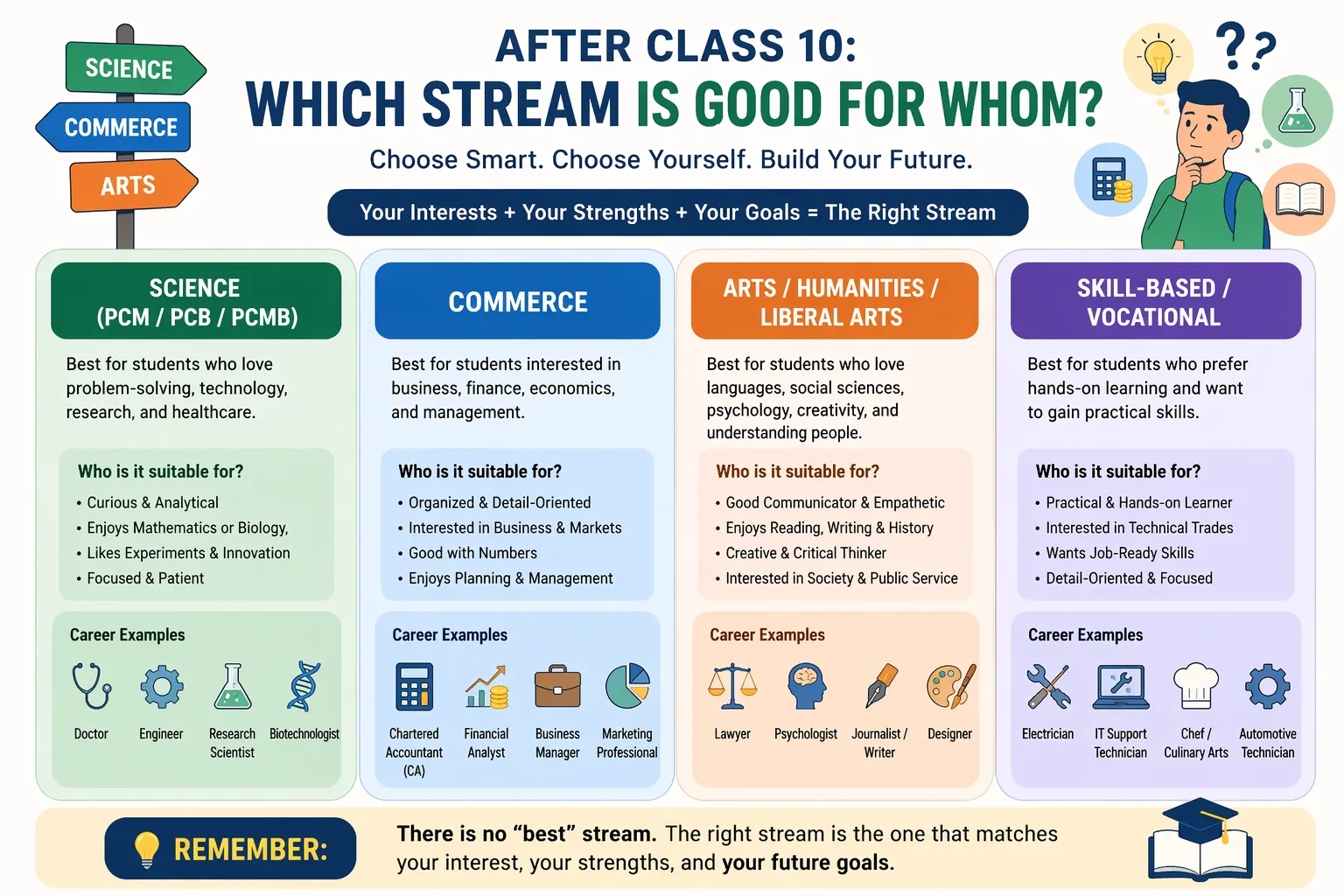
Selecting a stream for Class 11 is one of the most important decisions in a student’s life. The decision taken at this stage builds the foundation for future education and professional life. Science, Commerce, or Humanities—each stream contains different opportunities and challenges. Therefore, it is extremely important to take this decision by considering one’s own interests, abilities, and future goals, rather than blindly following what others are doing. Class 11 is not just another grade—it is the first turning point toward the future.
In this chapter, we will see how parents can help their children choose the right stream in a thoughtful and informed manner. The main goal here is that the decision should reflect the child’s genuine interests, abilities, and personality.
Main Streams at a Glance
1) Science (PCM / PCB / PCMB)
This is best for students who are attracted to technology, healthcare, research, and applied science. This stream opens doors to Engineering, Medicine, Data/AI, Pure Science, Pharmacy, Biotechnology, and many more fields. Within this stream, three main combinations can be chosen:
- PCM (Physics–Chemistry–Mathematics): Suitable for analytical students who love Mathematics. (Discussed in detail in Chapter 6.)
- PCB (Physics–Chemistry–Biology): Suitable for students interested in Biology and health-related fields. (Paths under PCB are discussed in Chapter 5.)
- PCMB: Keeps both paths open, but the academic load is much higher. It should be chosen only if your child has strong interest in both Mathematics and Biology and also has the ability to handle a heavy study load.
2) Commerce
This is excellent for students who enjoy business, finance, economics, management, and accounting. It leads to careers such as CA, Accounting, BBA, Economics, Finance, Analytics, Entrepreneurship, Sales, and Marketing. Adding Mathematics to Commerce increases career possibilities.
3) Arts / Humanities / Liberal Arts & Multi-stream Options
Arts / Humanities: This is ideal for students who love languages, social sciences, psychology, history, political science, law, design, media, education, and civil services.
Liberal Arts: This can be chosen at the college level. In this stream, a student is not restricted to only one specific subject. Instead, they get the opportunity to think and learn broadly through multiple disciplines. Liberal Arts means an education that teaches independent thinking. It is designed to build broad-base knowledge and integrated thinking.
Here, there is no strict division between Science, Commerce, or Arts. A student can study Social Sciences, Natural Sciences, Mathematics, or even Software together.
In colleges that offer Liberal Arts, students from any stream can apply at the college level. However, to pursue Liberal Arts in a good college, the right subject choices in +2 and some special preparation are necessary.
Multi-stream opportunities: There are many college-level courses, and even jobs, where students from different school streams can enter. For example, Hotel Management, BBA/MBA, Civil Services, Defence, Police, Central/State Services, Banking, and many more. However, if the goal is identified early and the right subjects are chosen in Class 11, reaching that goal becomes much easier.
4) Skill-based / Vocational
This is a type of education where the main goal is to learn through hands-on work and gain practical skills, rather than only theoretical knowledge. In this system, students are trained in such a way that they can directly become skilled in a specific profession, industry, or area of work.
Today, its growing opportunities are everywhere—advanced manufacturing, robotics, automobile, Solar / EV / Drone maintenance, computer and mobile repair, IT support, home appliance servicing, commerce, healthcare, technology, beauty and wellness, retail operations, logistics, and more.
In the second chapter, we learned how to observe a child’s aptitude, interest, and personality. Using those here, we can very easily identify the stream that is most suitable for the child.
1. Bio-Science: PCB (Physics, Chemistry, Biology)
This stream is the gateway to careers connected with life sciences, healthcare, and research.
Who is it suitable for?
- Curious: Those who are curious about the human body, animals, plants, and natural processes.
- Observant: Those who are interested in detailed analysis and systematic work, and are good at laboratory work.
- Compassionate: Those who have a tendency to help others and a strong desire to solve health and wellness-related problems.
- Focused: Those who have the patience and attention required for heavy study and have good memory.
If your child is initially suitable for the PCB stream, then look at the table below and see what future careers are possible through PCB. Check whether these careers are among your child’s preferences. Finalize the stream that is most suitable for your child and where their preferred careers are available.
| Field | Possible Careers |
|---|---|
| Medicine & Allied Health | Doctor (MBBS, MD), Dentist (BDS), Pharmacist, Physiotherapist, Nurse, Optometrist, Public Health Specialist. |
| Research & Life Sciences | Biotechnologist, Microbiologist, Geneticist, Forensic Scientist, Research Scientist, Clinical Data Manager. |
| Agriculture & Environment | Agricultural Scientist, Horticulturist, Environmental Scientist, Wildlife Biologist, Veterinarian. |
| Emerging Fields | Bioinformatics Specialist, Health Informatics Professional, Clinical Research Coordinator. |
2. Pure Science: PCM (Physics, Chemistry, Mathematics)
This stream is suitable for students attracted to Engineering, Technology, problem-solving, and abstract analysis.
Who is it suitable for?
- Analytical: Those who love working with numbers and logic, enjoy complex puzzles, and constantly ask “how” or “why.”
- Problem-solvers: Those who like tackling challenges, designing systems, and building models.
- Technology-oriented: Those who are interested in machines, computers, robotics, and future innovations.
- Abstract learners: Those who can quickly grasp visualization, mathematics, logic, and systems analysis.
If your child is initially suitable for the PCM stream, then look at the table below and see what future careers are possible through PCM. Check whether these careers are among your child’s preferences. Finalize the stream that is most suitable for your child and where more of their preferred careers are available.
| Sector | Possible Careers |
|---|---|
| Engineering & Technology | Mechanical Engineer, Electrical Engineer, Computer Engineer, Civil Engineer, Aeronautical Engineer, Robotics Specialist. |
| IT & Data | Software Developer, Cloud Engineer, Data Scientist, AI Specialist, Cybersecurity Expert. |
| Aviation & Defence | Pilot, Aeronautical Engineer, Defence Technologist, ISRO/DRDO Researcher. |
| Research & Science | Physicist, Mathematician, Pure Researcher, Astronomer, Architect, Urban Planner. |
3. Commerce
This stream prepares students for the commercial world by teaching business, accounting, finance, economics, and management.
Who is it suitable for?
- Organized children: Those who are accurate, detail-oriented, and enjoy structured work like managing finances or organizing events (even their pocket money).
- Business-minded: Those who have a natural curiosity about how markets, companies, and the economy work.
- Interested: Those who want to work in marketing, sales, accounting, or business in the future.
| Sector | Career Examples |
|---|---|
| Accounting & Finance | Chartered Accountant (CA), Company Secretary (CS), Cost & Management Accountant (CMA), Financial Analyst, Investment Banker. |
| Management & Business | Business Administration (BBA), Human Resources, Sales and Marketing Management, Retail Management. |
| Economics & Analytics | Economist, Statistician, Business Analyst, Data Analyst (especially with Mathematics). |
| Law & Commerce | Corporate Law, Tax Law, Company Law (often pursued with a Commerce background). |
4. Arts, Humanities, and Liberal Arts
This stream is suitable for those interested in human behaviour, society, culture, language, and creativity.
Who is it suitable for?
- Empathetic and communicative children: Those who like listening to others, show skill in writing and speaking, and are fascinated by human behaviour (Psychology).
- Critical thinkers: Those who enjoy debating, researching historical or social issues, and analyzing literature or policy.
- Creative: Those interested in visual art, design, performance, media, or creative writing.
- Public service oriented: Those interested in civil services (UPSC), social impact, law, or justice.
| Sector | Career Examples |
|---|---|
| Civil Services & Law | UPSC / State Civil Services, Lawyer, Judge, Policy Analyst, Diplomat. |
| Media & Communications | Journalist, Content Writer, Editor, Public Relations Specialist, Marketing Communications Professional. |
| Design & Creative Arts | Graphic Designer, Fashion Designer, Animator, Photographer, Interior Designer. |
| Social Sciences | Psychologist, Sociologist, Historian, Teacher, Counsellor, Social Worker. |
5. Vocational / Skill-Based Education
This path focuses on hands-on training so that job-ready skills can be built quickly, often leading directly to employment or specialized diploma courses.
Who is it suitable for?
- Hands-on learners: Those who do not learn best through traditional classroom lectures and theory, but rather through practical work.
- Practical: Those who do well in mechanics, electronics, maintenance, and technical trades.
- Career-focused: Children who prefer a faster path to employment or want a strong specialized skill before going to college.
- Detail-oriented: Students who show ability in specific, repeatable tasks such as electrical wiring, equipment repair, or culinary work.
| Sector | Example Career Paths |
|---|---|
| Technical Trades | Electrician, Plumber, HVAC Technician, Automotive Mechanic / EV Maintenance Specialist, Welder. |
| IT & Services | Computer Hardware Technician, IT Support Specialist, Web Designer (Diploma), Animation and Multimedia. |
| Healthcare Support | Medical Lab Technician (Diploma), Home Health Aide, Emergency Medical Services (EMS). |
| Hospitality & Design | Chef / Culinary Arts, Beauty and Wellness Therapist, Retail Operations Manager, Logistics and Supply Chain Support. |
[…] After Class 10: Which Stream Is Good for Whom? […]