
AI and Your IT Career: What Mid-Career Professionals in India Should Do Now
17th November, 2026
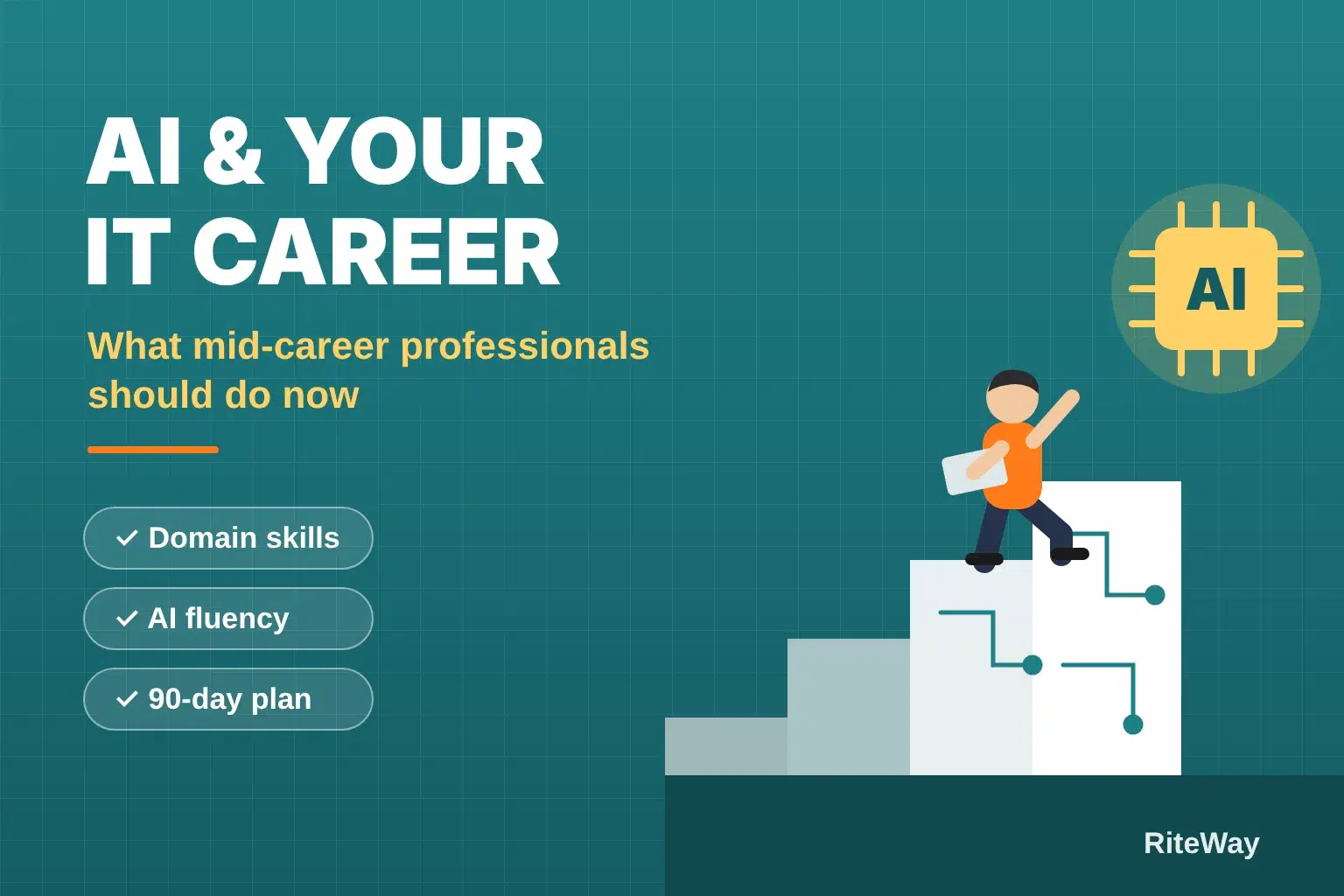
If you are 8 to 20 years into an IT career in India, you have probably felt it this year: fewer openings at your level, teams being reshaped around AI tools, and quiet worry in every corridor conversation. The good news is that the latest research does not show AI wiping out experienced professionals. It shows something more specific, and more useful: the career ladder is changing shape. This guide explains what the data says, which roles are under pressure, which are growing, and a practical 90-day plan to stay ahead.
What the Latest Data Actually Says
In February 2026, ICRIER (the Indian Council for Research on International Economic Relations) published a study of 650 IT firms across 10 Indian cities, covering more than 1,900 business divisions. Its key findings:
- No mass layoffs from AI so far – hiring has moderated mainly at the entry level, while mid and senior levels have stayed broadly stable.
- Domain + AI is the winning combination – 63% of firms reported higher demand for people who combine domain expertise with AI or data skills.
- Productivity is rising – divisions that increased output with stable or smaller teams outnumbered those with productivity declines by about 3.5 to 1.
- Training is lagging – only a small share of firms have trained more than half their workforce on AI tools.
At the same time, large employers are restructuring. TCS announced in 2025 that it would cut about 12,000 roles, mostly at mid and senior levels, as it reshaped teams for an AI-led model. Put together, the message is clear: experience is still valued, but only when it is paired with the ability to work with AI.
Roles Under Pressure
The work most exposed is work that is repetitive, rule-based, or mainly about passing information between people:
- Pure coordination roles – status tracking, reporting, and follow-ups that project tools and AI assistants now handle.
- Manual testing and routine support – increasingly automated or AI-assisted.
- Managers without a hands-on edge – people managers who no longer understand the work their teams do are easier to remove when teams shrink.
- Single-technology specialists – deep skill in one legacy platform, with nothing adjacent, is a narrowing bet.
Where the Opportunity Is Growing
- Domain experts who use AI well – banking, insurance, healthcare, retail, and manufacturing knowledge, combined with AI and data skills, is exactly what 63% of firms say they want.
- AI adoption and change leaders – someone has to redesign processes, train teams, and manage risk. Experienced professionals are best placed for this.
- Architects and problem framers – AI writes more code, so the value moves to deciding what to build and how the pieces fit.
- Client-facing and consulting roles – trust, judgement, and relationships remain human strengths.
- Governance, quality, and security – checking AI output, protecting data, and meeting regulations is growing work.
A 90-Day Plan for Mid-Career Professionals
- Days 1–15: Take stock honestly. List the tasks in your week. Mark which ones AI could do today, which it could assist with, and which need your judgement. Your future lies in the third list.
- Days 15–45: Use AI every day, at work. Pick two real tasks (a report, a design review, test cases, a client summary) and do them with an AI assistant. Learning by doing beats any certificate.
- Days 30–60: Deepen your domain. Choose the industry you know best and learn how AI is changing it. Read case studies, talk to people in the business side, and understand their problems.
- Days 45–75: Make your value visible. Share one small AI win with your team, offer to help others adopt a tool, or write a short LinkedIn post on what you learned.
- Days 60–90: Decide your direction. Grow where you are, move to an adjacent role, or plan a bigger shift. Decide deliberately, not in panic after a restructuring email.
Signs It’s Time for a Deeper Career Rethink
- Most of your week is coordination or reporting, and you can see tools taking it over.
- You have not learned anything meaningfully new in the last two years.
- You feel stuck, anxious, or bored, and cannot clearly say what you want next.
- You are considering an MBA, a master’s, or a career switch, but are unsure if it is the right move.
These are normal moments in a long career, and they are much easier to navigate with a structured conversation than alone.
FAQs
Is AI going to take away mid-career IT jobs in India?
Current research shows AI is reshaping roles rather than causing mass layoffs. Entry-level hiring has slowed the most. Mid-career professionals who combine experience with AI skills are in demand.
Do I need to become a data scientist or learn to code AI models?
No. Most professionals need to become skilled users of AI in their own field, not builders of AI models. Domain knowledge plus practical AI use is the combination employers ask for most.
Should I do an MBA or a master’s in AI to stay relevant?
Sometimes, but not by default. A degree is a big investment of time and money. First get clear on the role you want, then check whether a degree is truly needed for it.
How can career coaching help?
A coach helps you step back, understand your strengths and options, test ideas before committing, and build a realistic plan, so you act from clarity rather than fear.
Sources: ICRIER study on AI and jobs in Indian IT firms (February 2026, reported by PTI); TCS workforce announcement (2025). Figures are from these public reports and may change as new data emerges.