
Stay, Shift or Quit? How Mid-Career Professionals Can Make the Right Career Decision
22nd November, 2026
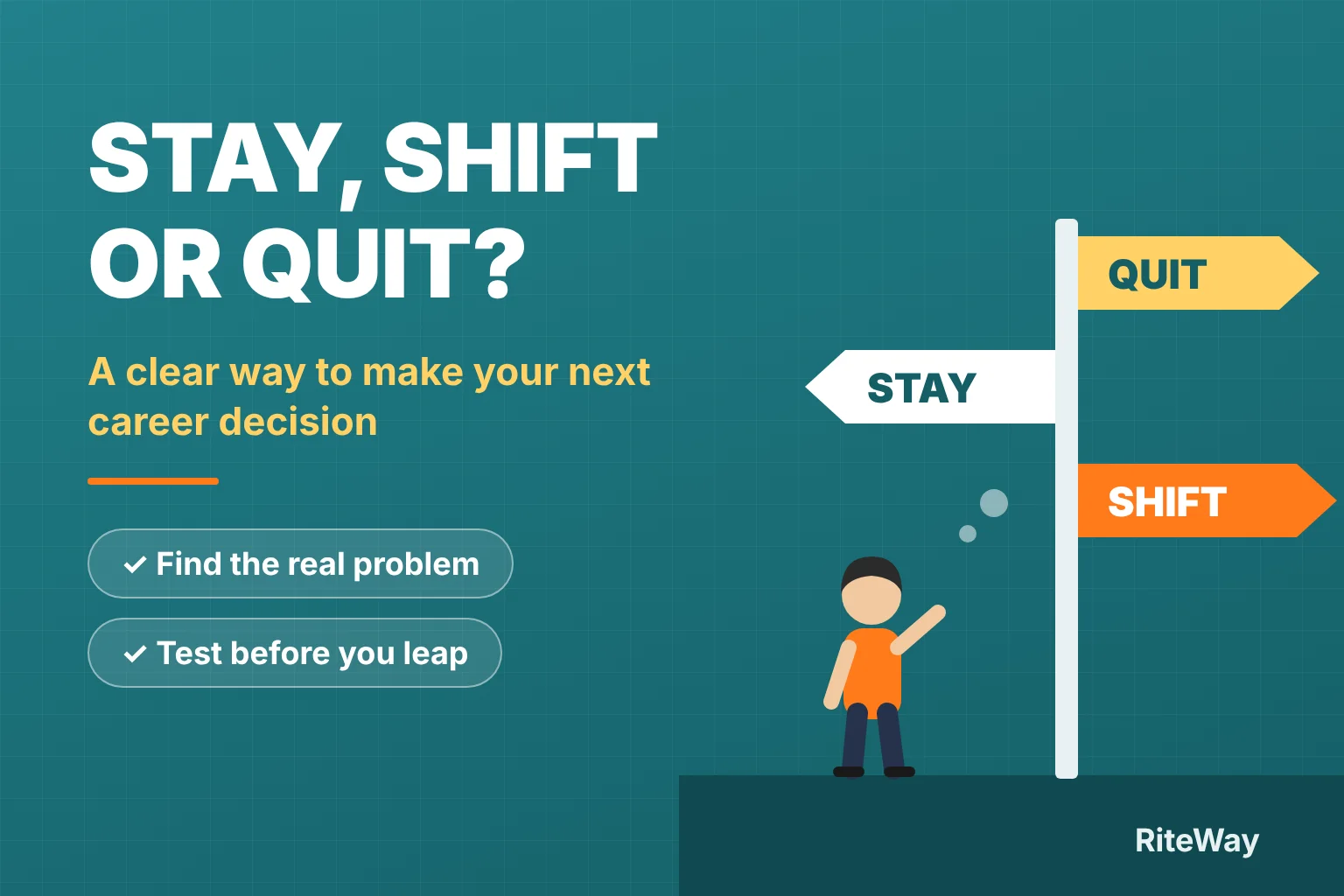
You are good at your job. You have the title, the salary and the experience. Yet on Sunday evenings something feels off, and the thought keeps returning: should I quit? For many professionals 10 to 20 years into their careers, this question shows up quietly and then refuses to leave. The trouble is that most people answer it in one of two unhelpful ways: they either ignore it for years, or they act on it suddenly after one bad week. This guide offers a calmer middle path: a simple way to decide whether to stay, shift or quit, and how to test your answer before you bet your career on it.
Stay, Shift or Quit: Three Different Answers
“Should I quit?” sounds like a yes-or-no question. In reality there are three distinct options, and confusing them is where most bad decisions begin.
- Stay and reshape – keep your employer, but change what you do: a new project, a different manager, a stretch role, or renegotiated working hours.
- Shift – move to a different role, function or industry where your experience still counts, such as from delivery to product, from operations to consulting, or from a large firm to a growing one.
- Quit and rebuild – leave to start something new: your own business, a sabbatical, further study, or a completely different field.
Each answer suits a different problem. The first step is to find out which problem you actually have.
Step 1: Find the Real Source of the Restlessness
Career restlessness usually comes from one of four places. Be honest about which one fits you best:
- The work itself – you no longer find the work meaningful or interesting, whichever company you imagine doing it for.
- The environment – the work is fine, but the manager, the culture or the politics are wearing you down.
- Growth – you feel stuck at the same level, learning nothing new, while others move ahead.
- Life outside work – health, family, burnout or a change in values is asking for a different balance.
This matters because each source points to a different answer. A toxic environment can often be fixed by staying in your field and moving employer. A growth problem is often solved by a shift. Only when the work itself has lost its meaning does a bigger rebuild usually make sense. Quitting to escape a bad manager, only to find the same frustration in a new job, is one of the most common and costly career mistakes.
Step 2: Five Questions to Ask Yourself
Take an hour, away from your phone, and write down your answers. Writing slows you down and shows you what you really think.
- What specifically drains me, and what specifically energises me? List real moments from the last three months, not general feelings.
- If my company fixed one thing, would I want to stay? If yes, the answer may be “stay and reshape”. If no fix would be enough, look wider.
- Which of my strengths do I want to use more? Your next move should lean on strengths you enjoy using, not only the skills you happen to have.
- What would I regret not trying in five years? Regret is a useful signal. It separates real aspirations from passing frustrations.
- What is my financial runway? Know how many months you could manage on reduced income. This turns fear into a number you can plan around.
Step 3: Test Before You Leap
The best career changes are rarely one dramatic jump. They are a series of small, low-risk experiments that show you whether the new direction is real. Before resigning, try a few of these:
- Talk to three people who already do the work you are considering. Ask what a normal week looks like, what they wish they had known, and what the move cost them.
- Run a side project for six to eight weeks, such as a small consulting assignment, a course with a real project, or volunteering in the new area.
- Try it inside your company first – an internal transfer, a cross-functional project or shadowing another team can test a new direction with no risk to your income.
- Notice your energy – after each experiment, note whether you felt more alive or more drained. Your energy is better evidence than your assumptions.
After two or three experiments, the choice between staying, shifting and quitting usually becomes much clearer. In many cases it almost makes itself.
Common Mistakes to Avoid
- Deciding in a bad week – strong emotions are signals to explore, not instructions to resign.
- Copying someone else’s move – a colleague’s successful switch into product management or a startup says little about whether it suits you.
- Chasing the title instead of the work – a bigger role that removes the parts of the job you enjoy rarely ends the restlessness.
- Assuming it is “too late” – mid-career professionals bring judgement, networks and credibility that are valuable in a new role. The move may take longer, but experience is an asset, not a barrier.
- Going it alone – thinking in circles in your own head is exhausting. A structured conversation often breaks a loop that has run for months.
When to Get Help
Consider talking to a career coach if:
- You have been asking yourself the same question for more than six months.
- You feel stuck between options and keep changing your mind.
- The restlessness is affecting your sleep, health or relationships.
- You are facing a forced decision, such as a layoff, restructuring or relocation, and need to decide quickly but wisely.
At RiteWay, our Career Navigator programme helps experienced professionals work through exactly these questions over a series of one-to-one sessions: understanding what is really driving the restlessness, exploring realistic options, testing them, and leaving with a clear decision and a plan. It starts with a free, no-obligation conversation.
FAQs
How do I know if I should quit my job or just change companies?
Ask whether you would still feel the same doing similar work for a better employer. If a better manager or culture would solve it, change companies. If the work itself no longer fits you, consider a bigger shift.
Is it too late to change careers after 40?
No. Many professionals make successful changes in their 40s and 50s. The key is to build on transferable strengths such as leadership, domain knowledge and judgement, and to test the new direction before committing fully.
Should I resign before I find my next role?
Usually not. Unless your health or wellbeing demands it, test and plan while you are still employed. It reduces financial pressure and lets you choose rather than settle.
How can career coaching help with this decision?
A coach helps you separate the real problem from the noise, see options you may have missed, design low-risk experiments, and reach a decision you feel confident about.